
Borden County Released Inmate Records
Borden County has an unusual custody structure. The Sheriff's Office makes arrests and keeps local records, but contemporary prisoners are housed in another county's jail. The physical jail creates the booking, custody, property, and release entries. The Borden County clerk holds the criminal case. One search cannot reliably replace all three sources.
A release record should answer who left custody, which agency released the person, when staff completed the event, and what authority or destination applied. A name disappearing from a live roster cannot answer those questions. It may reflect bond, time served, transfer, a correction, a new hold, or another agency taking custody.
The first practical step is to call the Borden County Sheriff's Office. Ask where the person was booked and which office now owns the release or transfer record. Those are separate questions. The result determines whether to contact a county jail, TDCJ, a federal agency, or the clerk.
Borden County Release Types Explained
The word “released” has several meanings. Each one sends the search to a different next source. The jail's code and destination field should be read together, and a local code should be requested with its definition.
| Release type | Meaning | Next record |
|---|---|---|
| Bond | Pretrial detention ends while the case and bond terms continue | Borden court docket and bond order |
| Time served or sentence satisfied | The credited jail term is complete | Judgment, jail credit, and jail release entry |
| Court ordered or dismissed | A judicial act authorizes release in that matter | Signed order plus the physical jail timestamp |
| Transfer | One custodian ends its hold as another begins custody | Receiving jail, TDCJ, USMS, or ICE record |
| Parole or mandatory supervision | A state prisoner serves part of the sentence in the community under TDCJ oversight | TDCJ status and assigned parole office |
| Discharge | The sentence or supervision duty ends | Final TDCJ or court record |
Death may close custody, but it must not be described as a return to the community. A booking photo only documents intake. Neither a photo nor an arrest entry proves guilt, present custody, or release.
Borden County Release Record Fields
A narrow field inventory makes a request easier to route and reduces false matches. Identity fields connect the correct person to the correct booking. Event fields show what staff did. Court and destination fields explain why the jail acted and whether custody continued.
| Field | What it establishes |
|---|---|
| Full name, aliases, date of birth | The identity used for the booking |
| Booking and agency numbers | The exact arrest and custodian record |
| Arresting and housing agencies | Borden's role and the physical jail |
| Booking and release timestamps | Start and end of that jail's custody |
| Release reason or code | Bond, sentence completion, order, transfer, or another event |
| Bond type and amount | The bond tied to a pretrial exit |
| Charge, court, cause number | The judicial matter connected to custody |
| Holds and receiving agency | Whether another authority continued confinement |
| Property receipt and photograph | Intake and property handling, not proof of release |
Where two timestamps differ, keep both with their source. A judge can authorize release before jail staff receive the order, clear holds, return property, and close the record. The order time and physical departure time describe different steps.
Request Borden County Release Records
Send each request to the office that possesses the item. Borden Sheriff can provide arrest and commitment information and identify the housing jail. The housing sheriff is the likely custodian of the jail card, final release or transfer line, code definition, property receipt, and booking image. The clerk handles filed court material under the rules that govern judicial records.
- Identify the person with a full name and date of birth or booking number.
- Give Borden Sheriff the arrest date and ask which jail received the person.
- Ask the housing jail for the booking sheet and final release or transfer entry.
- Request the date, time, reason, destination, holds, and definition of any coded disposition.
- Ask for electronic copies and a written cost estimate before work exceeds a chosen amount.
- Request any public part that can be separated if protected details must be redacted.
A useful request is limited to one person and custody episode. Under Texas Government Code §552.301, an agency seeking an Attorney General ruling generally must act within ten business days and send required materials within fifteen business days. Those deadlines do not promise that records will arrive within ten days. Charges depend on medium, labor, programming, and volume. Borden publishes no flat release-record fee.
Borden County Release Record Law
Texas Government Code Chapter 552 supplies the Public Information Act framework for executive-branch records. Sections 552.021 and 552.221 address access and prompt production. Section 552.234 covers an agency's designated request methods, and §552.2615 governs itemized cost estimates. Use the method posted by the agency.
Release and booking material is not automatically open in every detail. Law-enforcement exceptions, active investigations, privacy, victim data, medical facts, juvenile rules, and other statutes can require withholding or redaction. Judicial records have a distinct access framework, so court documents should be requested from the clerk rather than folded into a sheriff request.
Retention follows the record series and custodian. Borden states no online roster-retention period because it has no public roster. The Texas State Library schedules may treat a jail register, booking file, offense report, photograph, and property record differently. Ask which series applies.
Borden Release Records After Court Orders
An expunction order and an order of nondisclosure are not the same. Texas expunction law is principally in Code of Criminal Procedure Chapter 55A. Eligibility depends on the disposition, charge class, waiting rules, and related criminal episode. Nondisclosure generally limits public release but does not erase every form of government access.
Never assume that a dismissal removes a jail record or photo at once. Obtain the signed order and ask each source custodian how it applies. Juvenile records have separate confidentiality rules. If a field is wrong, contact the office that created it with the cause or booking number and supporting order.
The court record proves what a judge ordered. It may not prove the moment jail staff completed release. Pair it with the physical jail entry for a full timeline.
Which Borden Clerk Holds Records?
One elected official serves as both Borden County Clerk and District Clerk, but the two record types remain distinct. The county maintains separate official pages for those roles. A request should give the cause number, defendant name, and type of criminal case, then ask which court owns the file.
Felony matters belong on the District Clerk route. County-level misdemeanor records go through the County Clerk route. The office does not handle traffic tickets. Filed records should be sought from the clerk, not the judge or prosecutor, unless a rule directs otherwise.
Ask for the docket sheet plus the signed bond order, dismissal, judgment, sentence, jail-credit calculation, revocation, modification, or discharge document that fits the claim. A pending docket after bond is normal. Release from jail does not end the prosecution.
Find Borden County Released Inmates
The most reliable search path follows custody rather than putting a name into every database. Begin with the Borden arrest, trace the physical jail, confirm its event, and reconcile the court case. Move to a state or federal system only when the record shows that kind of custody.
- Call Borden Sheriff and identify the jail that held the booking.
- Search that jail's live system if it has one, but use the release log for a past event.
- Obtain the release time, reason, holds, and receiving agency.
- Match the Borden cause number, bond, judgment, or other signed order.
- If the event says transfer, search the named receiving system.
- Check parole, probation, or registry status only when the case makes it relevant.
- Preserve the exact status phrase and the time each source was checked.
Borden does not publish a 24-hour or 72-hour feed. A named search is therefore different from watching a list. The Borden County 24-hour release process explains how to define a same-day log request without inventing an online feed.
Borden Release Records Need Three Custodians
Outsourced detention creates a three-custodian chain. Borden Sheriff owns the local arrest role and can identify the destination. The housing jail records physical intake, release, property, and transfer. The Borden clerk records judicial authority and case disposition. Any one database can look incomplete while remaining accurate within its limited role.
For “bonded out,” pair the bond order with the jail release line. For “case dismissed,” obtain the dismissal and custody event because another hold may have continued detention. For “sent to TDCJ,” match the county commitment or transfer record to state admission. For “probation ended,” obtain the signed termination order and do not treat that later date as the original jail release date.
A contemporaneous log helps when sources disagree. Record the exact spelling and identifier, each agency checked, the status text, update time, and staff contact. Classify each item as a prediction, legal authorization, custody event, supervision status, or later court result.
Borden County Recent Release Search
The sheriff publishes no official roster, recent-release archive, booking-photo feed, update cadence, or mobile jail app. That absence is a local fact. Do not substitute a commercial roster or infer release when a name vanishes from another county's current list.
For a recent event, phone contact is fastest. Ask Borden Sheriff for the housing jail, then ask that jail for a defined release-log interval. State the start and end times, time zone, and that the request concerns Borden arrests. For an older event, a written request and the criminal court file create a more durable trail.
The official sheriff page shows the real local access point. Review the Borden custody source before trusting a site that claims to show a Borden jail roster.
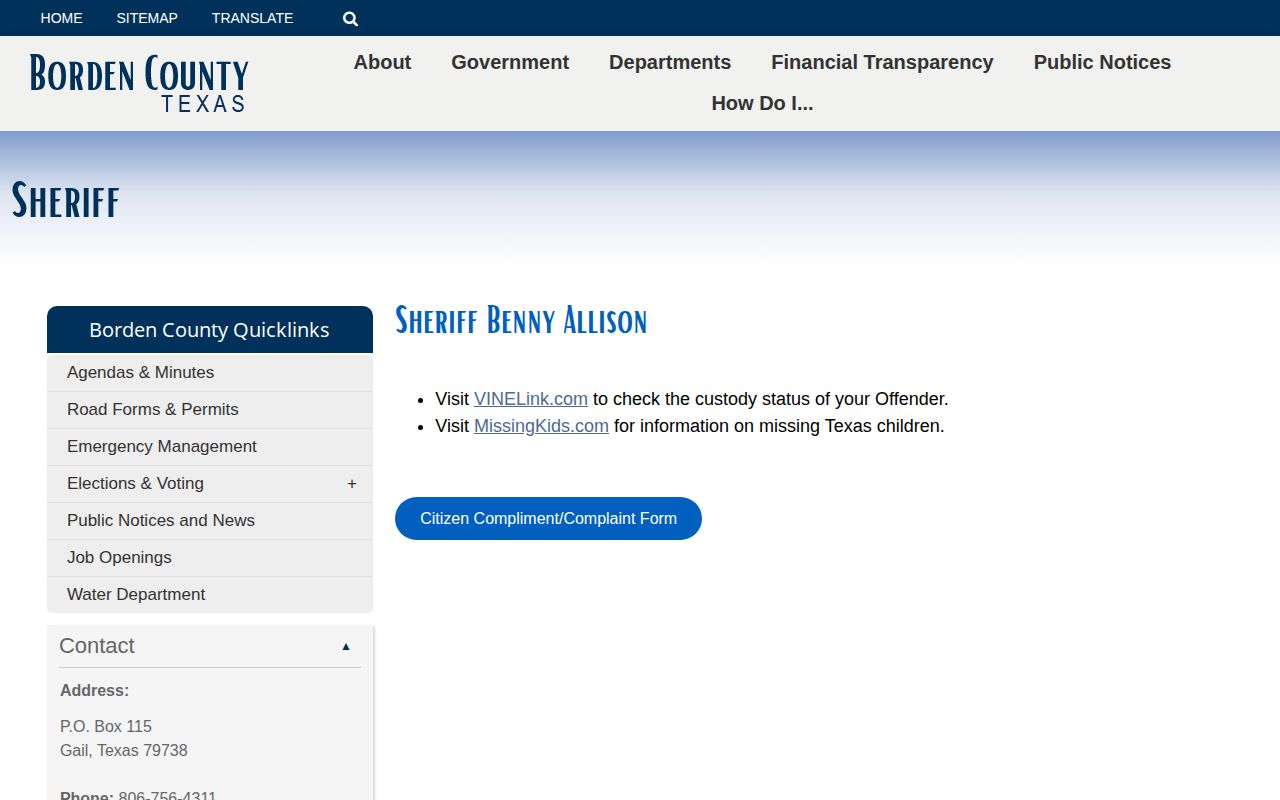
The captured page gives local contact information and an older VINELink referral, but no release rows, photos, filters, or retention statement.
TDCJ Search for Borden Releases
The TDCJ inmate search applies after admission to a Texas prison. TDCJ states that the online search includes only people currently incarcerated in a TDCJ facility. It updates on working days and is at least 24 hours old. It is not a released-inmate archive.
Search by TDCJ number or SID when possible. Otherwise use exact last name and at least a first initial, with optional gender and race. Compare identifiers, offense, conviction county, facility, status, sentence data, projected release, and parole fields. Borden as conviction county connects the state case; it does not mean a prison is located in Borden.
| Search field | Use | Limit |
|---|---|---|
| TDCJ number | Best direct identifier | Must match the assigned state number |
| SID | Texas criminal-history identifier | Use the full known value |
| Last name and first initial | Name-based fallback | Similar names require detail review |
| Gender and race | Optional result filters | Never replace identifier matching |
| Conviction county | Connects the TDCJ case to Borden | Does not identify facility location |
View the official TDCJ search interface before using a state-prison result.
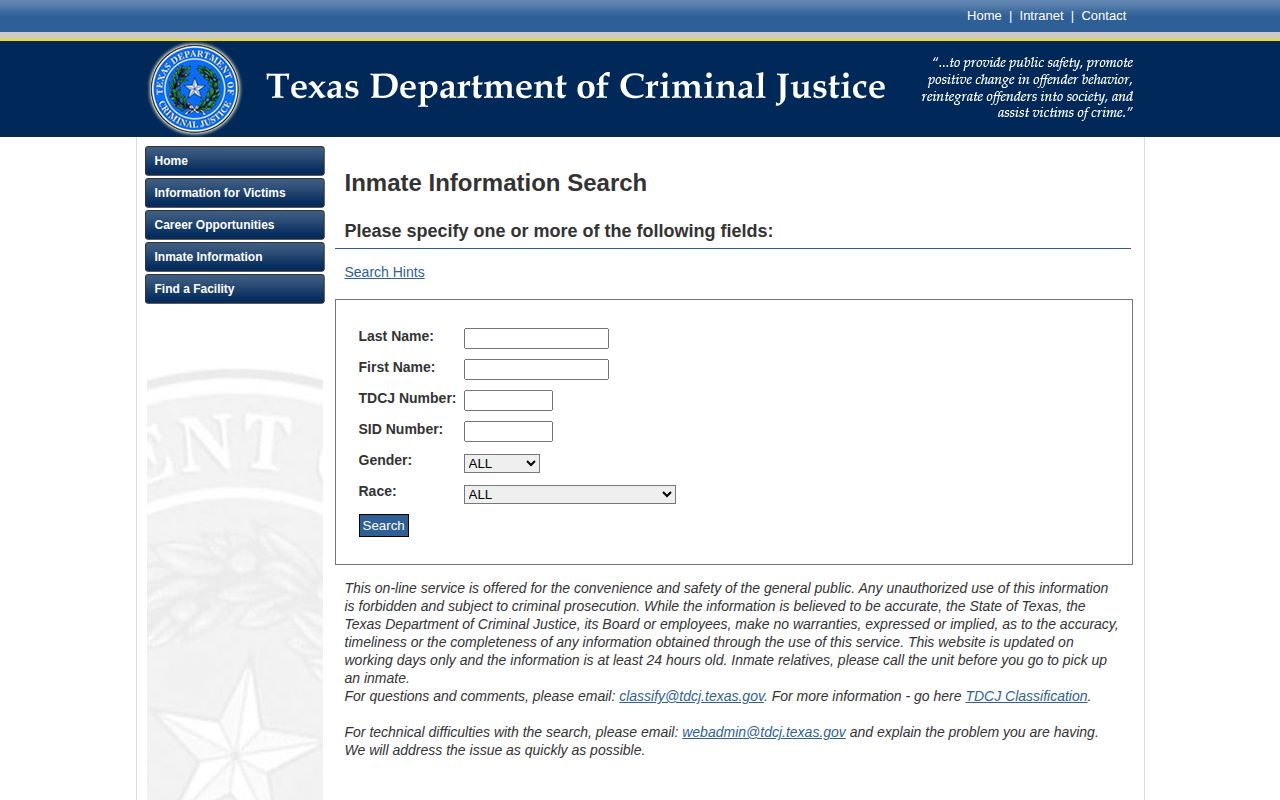
The interface supports current incarceration and projected information. A missing former prisoner requires the parole status line, IVSS history, a focused TDCJ public-information request, and the conviction record.
Borden Release Supervision Checks
Parole is discretionary release from prison to serve the balance under TDCJ Parole Division supervision. Mandatory supervision is a statutory state release path for qualifying cases. Community supervision, often called probation, is ordered by a court and may occur without a state-prison release.
- Parole
- Community supervision after a discretionary state-prison release.
- Mandatory supervision
- A statutory release mechanism subject to offense and approval rules.
- Probation
- Court-ordered community supervision tied to the judgment.
- Discharge
- The end of a sentence or supervision obligation.
For parole, use TDCJ status and the Parole Status Line. For probation, obtain the judgment and contact the community-supervision department named in it. A favorable parole vote is not proof that release processing finished.
Borden County Release Notifications
The sheriff page still points to legacy VINELink, but Texas moved county notification to IVSS-Counties in September 2025. The portal searches current custody or supervision where the feed participates. Someone already released may no longer appear, so a no-result is weak retrospective evidence.
TDCJ operates a separate IVSS portal for state prison and parole events. Select by custodian, not merely by conviction county. Alerts can flag release, transfer, discharge, or another event, but the releasing agency's record remains the final source.
Borden Federal and ICE Releases
The BOP locator covers federal prisoners, not routine Borden detainees. It can retain a name, register number, age, race, sex, release date, and released location or status. “Not in BOP custody” establishes only the federal bureau's status and may still leave another authority or supervision involved.
ICE's locator covers current immigration detention and certain recent releases, subject to data limits. If a county jail says “released to ICE,” the event is a transfer. The U.S. Marshals Service has no equivalent public historical locator, so a federal court order and responsible jail or district office must supply that trail.
Where Borden Release Status Appears
Choose the source that owns the custody stage. This prevents a current roster from being treated as a release archive and keeps county, state, federal, and immigration events distinct.
| Situation | Best source | What it proves |
|---|---|---|
| Recent Borden arrest | Sheriff plus physical housing jail | Custodian, release time, code, destination |
| Borden court case | County or District Clerk | Bond, judgment, dismissal, or other authority |
| Current TDCJ prisoner | TDCJ inmate search | State custody and projected fields, subject to lag |
| State release or parole | TDCJ IVSS, status line, records request | Event lead and supervision status |
| Federal prison case | BOP locator and federal court | BOP custody endpoint and judicial order |
| Immigration transfer | ICE locator and ERO | ICE custody within locator limits |
Historic Borden Jail Is Not Active
The 1896 native-stone jail in Gail is a local landmark and a search-engine trap. Its physical survival and appearance in directories do not make it a current detention operation. No modern Borden release trail starts there.
Current county budget material includes prisoner housing expense, and Texas Commission on Jail Standards reports document the housed-elsewhere model. Those sources are stronger than a directory that automatically creates a “Borden County Jail” profile.
The reports help establish the operating structure, but an older Garza County entry does not prove where one present-day prisoner was booked. Confirm every event with Borden Sheriff.
Borden County Release Facilities
Borden's facility map includes operational custodians and jurisdictional systems. Each has a distinct role in confirming where a person went.
- Borden County Sheriff's Office / Contract Jail Custody identifies the receiving jail and holds the local arrest record.
- Garza County Jail is a historically documented receiver, but use it only after matching the booking.
- Historic Borden County Jail is not a live custody or release source.
- Texas Department of Criminal Justice controls state-prison status, release, parole, and discharge after transfer.
- Federal Bureau of Prisons covers federal imprisonment and its custody endpoint.
- ICE Enforcement and Removal Operations covers immigration custody within federal locator limits.
No TDCJ, BOP, or ICE detention institution is identified inside Borden County. Their role arises only when a person enters that jurisdiction.
Public Record Search
Sponsored Results