
Borden County Same-Day Release Records
The Borden County Sheriff does not publish a current roster, recent-release list, 24-hour view, archive, or update schedule. That absence reflects the county's custody model. The sheriff arrests and keeps local records, while another jail may book and hold the detainee. The physical housing jail owns the most direct release timestamp, reason, property record, and transfer destination.
A useful same-day result therefore comes from matching records, not watching a Borden web list. Call the Borden County Sheriff's Office and ask where the person was booked. Then contact that jail for the exact period. Garza County Jail has housed Borden prisoners in past Texas Commission on Jail Standards reports, but that history does not prove where any present detainee was held.
Check Borden County 24-Hour Releases
Define the window before calling. Give the start, end, date, and time zone, and say that the request concerns Borden County arrests. A calendar date is not always the same as the preceding rolling 24 hours.
- Ask Borden Sheriff which jail received the detainee for that booking.
- Contact the housing jail and request its release log for the exact 24-hour interval.
- Ask whether each entry means bond, time served, court-ordered release, transfer, or another coded event.
- Follow any receiving-agency entry. A TDCJ, ICE, federal, or county transfer means custody continued.
- Compare the event with the Borden criminal case and preserve the time each source was checked.
For one named person rather than a daily group, the Borden County released-inmate search path explains how to reconcile the jail, court, and receiving system.
Borden County Release Fields
Because no public Borden feed displays fixed columns, request the fields needed to identify both the person and event. Ask for the local code definition as well as the code.
| Field | What it establishes |
|---|---|
| Name, birth date, booking number | Which booking the entry concerns |
| Arresting and housing agencies | Who made the arrest and who held the person |
| Booking and release times | Whether the exit falls inside the selected window |
| Release reason or code | Bond, time served, order, transfer, or another disposition |
| Charge, court, cause number | The case tied to the custody event |
| Holds and destination | Whether another agency took custody |
A booking photo proves intake, not release. Likewise, a court order authorizes an exit but does not show when staff completed it. The strongest record chain joins the order to the housing jail's timestamp.
Request Borden County Release Logs
Start by phone when the event is recent. If staff cannot provide the entry, send a narrow Texas Public Information Act request to the agency that created it. Name the exact 24-hour period, Borden as the arresting county, and the fields sought. Request a code legend and any segregable public portion if a field is withheld.
The clerk's record supplies the bond, dismissal, judgment, or release order. It does not replace the jail log. For a state-prison transfer, use TDCJ for current custody and projected information. For a wider records interval, use the Borden County 72-hour releases process.
Borden Release or Custody Transfer
Release is agency-specific. Bond, time served, and a completed court-ordered release can mark an exit to the community. Transfer means confinement continued elsewhere. A county jail may close its own custody entry when it delivers someone to TDCJ, another county, the U.S. Marshals Service, or ICE.
- Bond release
- The person leaves pretrial detention while the case continues.
- Time served
- The credited custodial term has been completed.
- Transfer
- One agency ends custody because another assumes it.
- Discharge
- A sentence or supervision obligation ends, which is broader than leaving one jail.
TDCJ's public inmate search covers people currently incarcerated in a TDCJ facility and can lag by at least a working day. A missing name does not prove release. County notification now runs through IVSS-Counties, while state prison and parole notifications use the separate TDCJ IVSS portal.
Why Borden Has No Release Roster
Borden County's defining data issue is the lack of an operating county jail roster. County budget records include prisoner housing expense, and the Texas Commission on Jail Standards reports document housed-elsewhere arrangements. A scraper labeled as a Borden jail list cannot reliably show the physical custodian.
Ask two questions every time: where was the person booked, and which agency now holds the release record? Those answers may differ. The sheriff can identify the destination jail, while that jail can confirm the actual timestamp and disposition.
No Borden Release App
The official sheriff page links an older VINELink route but provides no Borden jail app, mugshot feed, or recent-release tool. An app marketed under the county name is not official merely because it uses local words or imagery. Do not substitute a commercial directory for the absent public log.
Texas moved county notification to IVSS-Counties in September 2025. That portal can help with a specific person's custody event where the housing agency participates, but it is not a complete Borden 24-hour release list. The written jail entry remains the durable source.
Confirm Borden Same-Day Release Proof
Administrative systems can record different moments. A judge may sign a bond or dismissal order before the housing jail receives it. Jail staff may then need to verify holds, complete property return, and close the booking. The court time is legal authority; the jail time is the physical custody event. Keep both when the goal is to establish what occurred within one 24-hour window.
When the jail entry says transfer, ask for the receiving agency and movement time. Then seek an admission or status record from that agency. A TDCJ record concerns state prison custody. BOP covers federal prison custody. ICE's locator concerns immigration custody and has its own limits. None of those systems can replace the Borden arrest record or the housing jail's release line.
Negative results need careful wording. Record that a person was “not found in the named system” at the search time. Do not turn that result into a claim of release. Spelling changes, data lag, nonparticipation, and transfer can all produce an empty search. A later written response from the custodian can provide the final event and code.
Borden Sheriff Release Evidence
The official sheriff page is useful because it shows what the county actually offers and what it does not. Review the Borden County Sheriff custody page before relying on any third-party list.
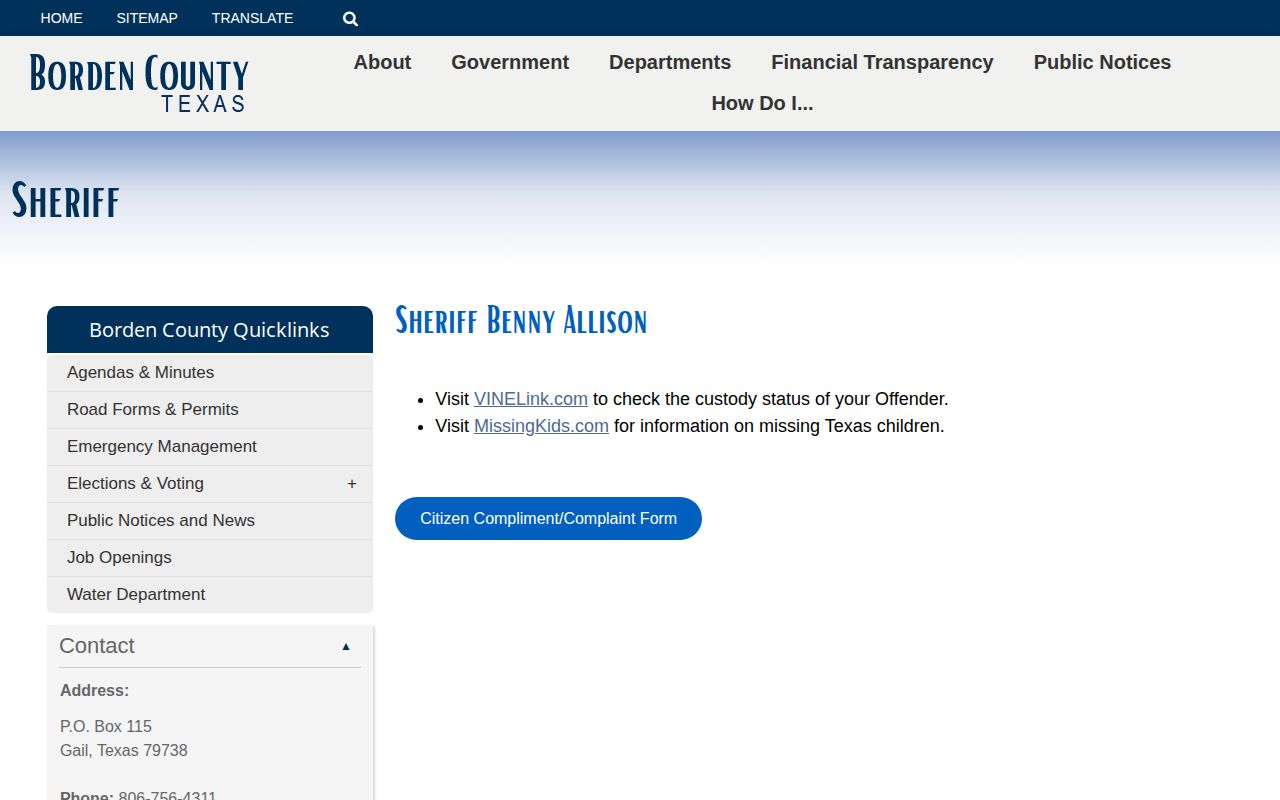
The captured page points users toward notification but contains no county roster, release table, photo gallery, filter, cadence, or retention statement. That visible absence supports the direct housing-jail and records-request route.
Match Borden Release Court Records
A Borden criminal record can explain why jail staff acted. Ask for the cause number, bond order, dismissal, judgment, sentence, jail credit, warrant status, and any signed release or transfer order that fits the event. Felony files belong with the District Clerk. County-level misdemeanor records belong with the County Clerk. One elected clerk serves both roles, but the request should still identify the right court and record type.
Use the order and custody entry together. A bond order can exist while another hold keeps the person confined. A dismissal can end one case while an unrelated warrant remains. A sentence can be complete in the Borden case while federal or immigration custody begins. These records are not contradictory when each describes a different legal or custody step.
The court record also helps resolve names and dates. Match the cause number, charging agency, arrest date, and defendant identifiers against the housing jail entry. If the timestamps differ, preserve each field with its source instead of selecting the more convenient time.
Retaining Borden Release Records
No Borden page promises how long released data stays online because no online list exists. The underlying material may still survive as a jail register, booking record, offense report, photo, property receipt, or court file. Each series can have a different retention rule under the Texas State Library schedules. A web result and an agency file are not the same thing.
Ask the custodian how it classified the requested item. That answer can explain why a release line remains while a related photo or property form does not. Expunction, nondisclosure, juvenile confidentiality, litigation holds, and agency policy may also affect access. If a field is wrong, send the correction request to the office that created it and include the record number plus supporting order.