
Borden County Parole Decision Stages
Texas parole result codes need careful translation. FI-1 is a favorable vote for release when the person is eligible. FI-2 points to a future month. FI-3R, FI-4R, and other codes ending in R can require transfer to a treatment or program path before a later release. A denial may set a new review interval, often called a set-off. A “serve all” result keeps the person confined until another lawful release or sentence expiration applies. None of these labels is a completed release timestamp.
The BPP identifies files for review before the eligibility date, but timing is case-specific. Offense date, offense type, consecutive sentences, and calendar-time minimums affect eligibility under Government Code §508.145. Mandatory-supervision exclusions appear in §508.149. Eligibility only means the case can be considered. It does not create a right to release. Use TDCJ's calculation and preserve the exact vote code instead of reducing every result to granted or denied. TDCJ generally identifies an initial file before eligibility and prepares a later review before the next review date. Those working windows do not promise release. Record eligibility, review, vote, and set-off dates as separate facts.
After a favorable vote, Review and Release Processing audits the case. Required programming, detainers, warrants, residence planning, and the release certificate can affect scheduling. TDCJ may then show a scheduled date and location, but its own guidance warns that those fields can change on release day. Call 512-406-5202 for an approved case still in processing. After release, switch to the Parole Status Line and the assigned district office. This stage-by-stage route is the best way to verify whether a Borden County person merely received favorable action, obtained a schedule, actually left prison, or entered active supervision.
Borden County Parole Versus Probation
Parole follows a prison sentence. The Texas Board of Pardons and Paroles, or BPP, decides whether an eligible person may serve part of that sentence in the community. The TDCJ Parole Division then supervises the release. Mandatory supervision is another statutory form of supervised release, but eligibility and approval depend on the offense date and law. Probation is the common name for court-ordered community supervision. A Borden County judge may order it instead of confinement or after a short jail term. The clerk's judgment, not a TDCJ parole screen, proves that order.
| Question | Parole or mandatory supervision | Probation |
|---|---|---|
| Who orders it? | BPP acts under Texas law after a prison sentence. | The sentencing court signs the order. |
| Who supervises? | TDCJ Parole Division. | The community supervision department named by the court. |
| Best proof | TDCJ status, release certificate, and assigned parole office. | Judgment, conditions, and later modification or discharge orders. |
| How it ends | Discharge, sentence expiration, or other official action. | Completion, early termination, revocation, or signed discharge. |
A county-jail release does not answer either question by itself. Borden houses prisoners outside the county, so a physical jail entry may show bond, time served, transfer, or another event. Match that entry to the Borden court case. If it shows transfer to TDCJ, follow the state trail. If the court imposed community supervision, follow the local court and department trail.
Verify Borden County Post-Release Supervision
Start with custody type, not a broad name search. TDCJ covers state prison, parole, and mandatory supervision. A Borden criminal judgment controls probation. The county sheriff can identify a housing jail, but it does not decide parole and may not supervise probation.
- Collect the full legal name and a TDCJ, SID, booking, or cause number when available.
- Search the TDCJ inmate information system before release and save the exact status, projected date, and review fields.
- After release, call the Parole Status Line at 844-512-0461 and ask whether supervision is active and which office is assigned.
- For probation, request the judgment and current supervision or discharge order from the Borden County/District Clerk.
- Confirm the office directly. Special caseloads and approved residence changes can alter the expected assignment.
TDCJ's online inmate search contains only people currently incarcerated in a TDCJ facility and is delayed by at least one day. A missing result after release is not a parole-status certificate. State IVSS notification history, the status line, the district office, and a narrow written TDCJ request provide the better post-release chain. For a complete custody and court trail, use the Borden County released-inmate search guide.
Note: Record the source, time checked, exact status phrase, and identifier so later updates can be compared without guessing.
Borden County Parole Office Route
TDCJ's county-to-office directory assigns Borden County to the Abilene District Parole Office in Region V. This is the county-specific starting point, not a guarantee that every releasee reports there. Confirm the actual assignment through the status line or Parole Division before relying on the directory.
Abilene District Parole Office
Address: 5241 West Stamford Street, Abilene, TX 79603
Phone: 325-672-1495
Fax: 325-734-5188
Source: TDCJ Region V office directory
The office can confirm its role and route a status question, but public verification should not seek a private home address. For an approved release that has not yet occurred, TDCJ Review and Release Processing handles a different stage. Its status number is 512-406-5202, with office information at 512-406-5449. Approval, scheduling, physical release, and active supervision can appear on separate dates.
Borden County Probation Record Route
The TDCJ Community Justice Assistance Division directory associates Borden County with Scurry County for community supervision. Still, the signed sentencing order controls. Begin with the Borden County/District Clerk at 117 E. Wasson in Gail, phone 806-756-4312. Ask which court owns the cause and request the judgment, conditions, modification orders, revocation entries, and termination or discharge order. One elected clerk serves both county and district courts, but their files remain distinct.
Probation can include regular community supervision or deferred adjudication. Deferred adjudication postpones a finding of guilt while the person follows court terms. Early termination requires an order. Revocation can result in a new custody event. A docket label alone may omit the signed terms, so request the order itself and then use the official community supervision directory to verify the department.
Borden County Parole File Votes
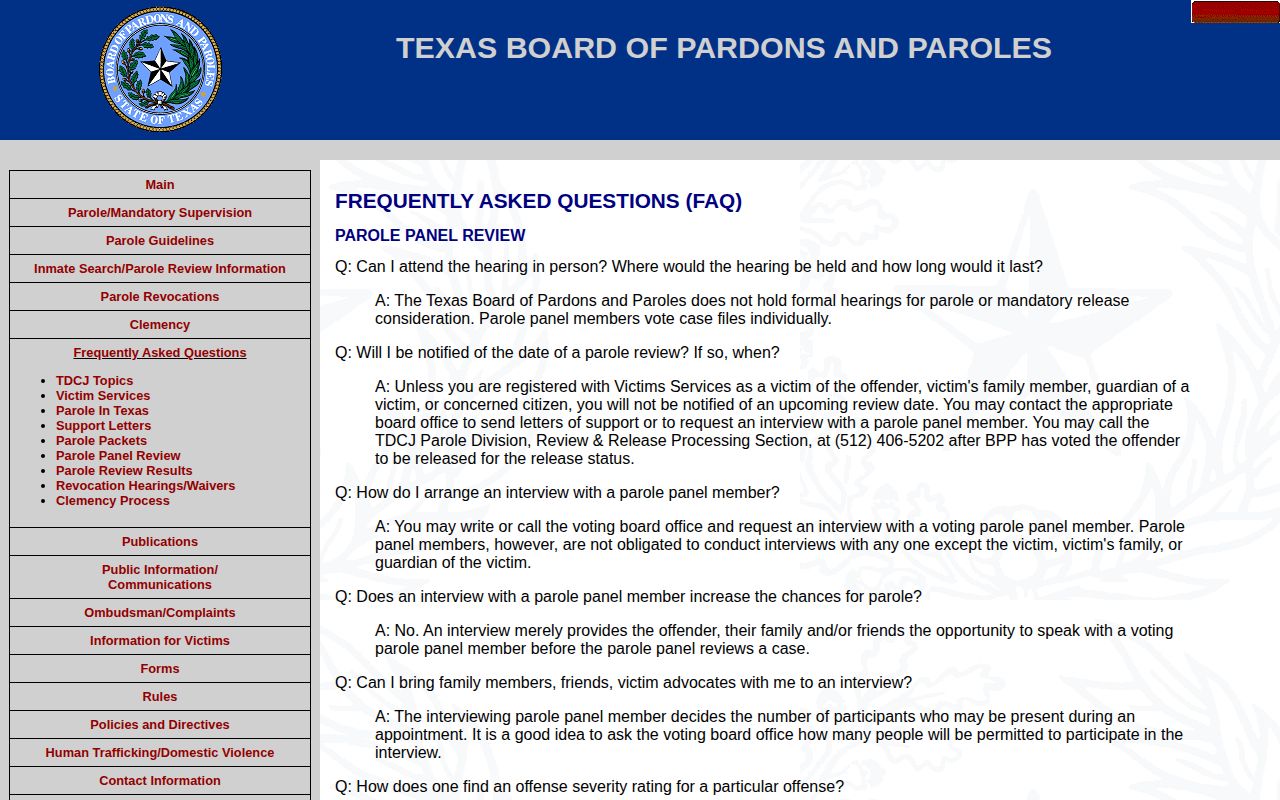
Texas does not use a public calendar of formal hearings for ordinary parole consideration. The BPP reviews files. A three-member panel votes in sequence, and two matching votes produce the result. The official panel review explanation confirms that parole and mandatory-release consideration is not conducted as a formal public hearing. Board workshop notices are agency meetings, not a schedule for named Borden County cases.
The practical schedule appears in the person's eligibility and review fields. TDCJ identifies files before the review date, and the panel may issue a favorable code, a denial with a later review interval, or a program-based result. FI-1 generally means favorable release when eligible. FI-2 names a future month. Codes such as FI-3R or FI-4R may require a treatment or program path. None proves the gate event occurred.
The file-vote distinction is visible in the BPP parole panel FAQ.
Borden County Supervision Violations
Conditions vary by order and case. Common categories can include reporting, approved residence, travel limits, treatment, fees, and compliance with the law, but only the release certificate or court order states the person's actual terms. An absconder is someone alleged to have stopped reporting or left supervision without authorization. It is a status requiring agency confirmation, not a conclusion to draw from a missed appointment or a stale web result.
For parole, TDCJ may issue a warrant and begin a revocation process after an alleged violation or new offense. Revocation hearings are separate from initial parole file votes. Use the Parole Status Line and the official revocation overview. For probation, consult the Borden docket for a motion, capias, warrant, hearing, and signed ruling. An allegation is not the same as a final revocation.
Notification portals can add context. TDCJ IVSS covers prison and parole events, including release, discharge, and some warrant changes. IVSS-Counties covers participating county and court feeds. Neither replaces the warrant-issuing office or signed court record.
When Borden County Supervision Ends
Physical release and discharge are different events. A person may leave prison on parole yet remain under supervision until the sentence expires or TDCJ issues a discharge. Probation ends through the term and court action shown in the record. A release from a contract jail may occur much earlier and merely mark the start of the court-ordered supervision period.
Request a durable endpoint. For parole or mandatory supervision, ask TDCJ for public release type, release date, final status, and discharge date, subject to lawful limits on parole-file information. For probation, request the signed termination or discharge order from the Borden clerk. If a case was revoked, follow the later judgment and custody admission. This record chain keeps a favorable vote, release certificate, scheduled date, completed release, and final discharge from collapsing into one event.
Public Record Search
Sponsored Results