
TDCJ Borden Release Destinations
The Borden County Sheriff's Office is the first stop for a Borden arrest, but it may not be the office that completed the physical release. The county budget contains prisoner housing expense, and Texas Commission on Jail Standards reports document outside housing. Ask the sheriff where the named person was booked for the relevant date. Garza County has appeared as a receiving county in historical reporting, but that evidence does not establish a permanent arrangement for every booking.
A final event may show bond, time served, a court-ordered release, transfer to TDCJ, movement on a writ, or delivery to another agency holding a detainer. Only the first group normally describes departure to the community. A transfer ends one custodian's hold and starts another. The physical jail's final entry should identify the timestamp, code, and destination. The Borden criminal file then explains the judicial authority.
| Record holder | What to request |
|---|---|
| Borden Sheriff | Arrest report, commitment, and receiving-jail identity |
| Housing jail | Booking card, final release or transfer entry, code definition, property receipt |
| Borden clerk | Bond order, disposition, judgment, sentence, or commitment |
Confirm TDCJ Borden Releases
Search TDCJ while the person remains incarcerated, save the identifiers and projected fields, then verify through state channels after the event. A current-inmate no-result is not historical proof because former inmates are outside the search's stated coverage.
- Search by TDCJ or SID number and compare the Borden conviction county.
- Record projected, scheduled, parole-review, and location fields without treating them as final.
- After the date, call the Parole Status Line and review TDCJ IVSS notices.
- Request the public final release or discharge record and match it to the conviction file.
The Borden release search path helps trace the earlier county-to-state transfer, while TDCJ controls the later prison release.
TDCJ Release Records Contact
TDCJ is a statewide system with no prison in Borden County. The public-information office holds state custody records, while Review and Release Processing answers processing-status questions. Use the Borden clerk only for the underlying conviction record.
TDCJ Public Information RequestPO Box 4017
Huntsville, TX 77342
Email: PIA@tdcj.texas.gov
Parole Status Line: 844-512-0461
Review and Release Processing: 512-406-5202
Ask for the existing release certificate, actual date and type, release location, incarceration history, and final public status. Expect lawful redaction of protected parole and inmate material.
TDCJ State Custody Scope
The Correctional Institutions Division manages sentenced state-prison custody. It is not a Borden county jail or a federal system. A Borden contract jail records delivery to TDCJ as its own transfer endpoint; TDCJ admission begins the state segment.
Parole and mandatory supervision may follow release from prison, while court-ordered community supervision can occur without a prison release. The BPP makes release decisions and the TDCJ Parole Division supervises eligible releasees. Keep those functions distinct from the prison unit and the local court.
Historic Jail Versus Releases
The 1896 native-stone jail in Gail survives as a local landmark, but it is not a present detention endpoint. Search engines and directory listings can blur that difference by attaching current-sounding roster language to the old structure. No contemporary Borden County release trail originates from the historic jail.
Modern custody evidence points outward. The budget pays for prisoner housing, and commission reports have listed Borden prisoners elsewhere. Anyone trying to verify a current release should call the Sheriff's Office, identify the actual booking jail, and ignore a directory that treats the stone jail as active. The separate Historic Borden County Jail record page addresses that data-quality trap.
Borden Release Record Fields
A complete request should seek the fields that distinguish release from transfer. Identity may rest on the full name, aliases, date of birth, booking number, and arresting agency. Event data can include booking and release times, charges, court, bond amount and type, holds, release reason, code definition, and destination.
- Bond release
- Departure from pretrial custody while the criminal case and bond terms continue.
- Time served
- Completion of the custodial term credited by the court and jail.
- Transfer
- Movement to another custodian, not freedom from custody.
- Discharge
- End of a sentence or supervision duty, which may occur well after jail release.
Where timestamps differ, preserve each agency's wording instead of choosing one. A court can authorize release before a jail completes processing, and a detainer can cause a later transfer.
Request Borden Release Proof
Texas Government Code Chapter 552 supplies the public-information framework for agency records. A request should ask for existing records, not require staff to answer broad questions. Specify electronic copies, ask for a cost estimate above a chosen amount, and request segregation of public parts if protected data must be withheld.
For the physical jail, request: “For [name and identifier], provide the booking sheet and final release or transfer entry showing date, time, reason, and destination for custody beginning [date]. If a code is used, provide its definition.” Add the property receipt or booking photograph only when relevant. A written record is more durable than a portal screen.
Correct Borden Release Errors
Send a correction request to the creator of the disputed field. The housing jail controls its release code and time. The clerk controls filed judicial entries. TDCJ controls its state status. Include the exact record identifier, the field at issue, and a supporting order or identity document.
Online absence has little force in Borden County because there is no official local released-person archive. Underlying records follow series-specific retention schedules, and some components may survive when others do not. Ask whether the item is classed as a jail register, booking record, offense report, photograph, or property record. Preserve the agency's reply and any revised record.
Search TDCJ Borden Records
The TDCJ inmate search belongs to the current-incarceration and pre-release stage. TDCJ states that it includes only people currently incarcerated in a TDCJ facility. Its information is updated on working days and is at least 24 hours old. A Borden conviction county connects the state record to a local case, but it does not mean that a state prison sits in Borden County.
Use a TDCJ number or State Identification number when available. Otherwise enter the exact last name and at least a first initial, with optional gender and race, then compare identifiers, offense, sentence, and conviction county. Save the status words and the time checked. A name collision or data lag can otherwise produce a false match.
| Search item | Use | Caution |
|---|---|---|
| TDCJ or SID number | Strong identity match | Verify digits |
| Conviction county | Connects a Borden case | Not a facility location |
| Projected release date | Pre-event estimate | Can be recalculated |
| Scheduled date and location | Shows advanced processing | Can change on release day |
TDCJ Projected Versus Released
Projected Release Date is a calculation by Classification and Records. It depends on the offense title and date, flat time, good-conduct treatment, parole action, and mandatory-supervision eligibility. It is not a historical certificate. For some eligible older offenses, flat plus good time can reach mandatory supervision. Later eligible cases also require BPP approval. Noneligible cases may project to maximum expiration unless parole occurs first.
After favorable action, Review and Release Processing evaluates the plan, county-of-residence rules, discipline, conditions, programs, and other criteria. A release certificate then moves to audit and calculation. TDCJ research notes that certificate processing may take roughly four to six weeks when needed information and an approved residence plan are present, followed by an audit that may take about 14 to 21 business days. These ranges are not promises.
- Projected release
- A changeable calculation of when incarceration may end.
- Scheduled release
- A date and place shown after processing has advanced.
- Parole
- Supervised service of the remaining prison sentence in the community.
- Discharge
- The endpoint of the sentence or supervision obligation.
Confirm a TDCJ Release
A person who physically leaves prison may disappear from the current-inmate search even while parole continues. That disappearance is consistent with release, but it does not prove the event. It may also reflect a correction or custodial movement. Use several state channels after the expected date.
- Call the Parole Status Line at 844-512-0461 with enough identity data to avoid a false match.
- Review any saved TDCJ IVSS notification and distinguish release from transfer, warrant, or discharge.
- If supervision applies, confirm the assigned district office. Borden County normally maps to the Abilene District Parole Office, but special assignments can differ.
- Request releasable final-status, release-certificate, release-date, release-type, and incarceration-history records from TDCJ.
- Match the state event to the Borden conviction judgment and later court orders.
The Abilene District Parole Office is at 5241 West Stamford Street, Abilene, Texas 79603, phone 325-672-1495. An office assignment confirms supervision routing, not a private residence or the exact prison-gate time.
Request TDCJ Release Records
TDCJ accepts public-information requests through its online route, by email at PIA@tdcj.texas.gov, by mail to TDCJ Public Information Request, PO Box 4017, Huntsville, TX 77342, or by hand delivery to 2 Financial Plaza, Suite 600, Huntsville. Ask for existing public records rather than an unsourced calculation.
A focused request can seek the release certificate, actual release date and type, unit or release location, incarceration history, and final status. Government Code sections governing inmate and parole material permit lawful redaction, so do not demand an entire confidential parole file. TDCJ's public email information route can provide identifiers, location, conviction information, incarceration history, and projected date, but expressly excludes photographs.
TDCJ posts cost guidance rather than a guessed Borden fee. Fewer than 50 paper pages generally cost ten cents per page plus delivery. Larger matters may add labor and overhead. For an estimate above $40, the requester must answer in writing within ten days. An Attorney General ruling can add substantial time.
TDCJ Good-Time Limits
Texas Government Code Chapter 498 treats good conduct time as a privilege that affects eligibility and calculation and can be forfeited. It is not an automatic cut to the judicial sentence. Government Code sections 508.145 and 508.149 make parole and mandatory-supervision rules depend on offense, offense date, sentence, and exclusions.
The common claim that every Texas prisoner serves 85 percent is wrong. For listed offenses, section 508.145(d) can require actual calendar time equal to one-half of the sentence or 30 years, whichever is less, with a minimum of two years. Good time does not count toward that calendar minimum. The “85 percent” shorthand more often describes federal credit practice and should not be imported into a TDCJ case.
TDCJ Transfer from Borden
A contract county jail entry stating “released to TDCJ” is a transfer. It proves the county custodian ended its hold and delivered the person to the state system. Match that entry to TDCJ admission before describing the new status. The Borden court commitment explains why state custody began.
Reasons a later date may change include disciplinary forfeiture, restored credit where allowed, amended jail credit, consecutive cases, a new hold, BPP approval or denial, program completion, residence-plan approval, certificate audit, and administrative scheduling. Preserve each agency's dated language instead of forcing all records into one timestamp.
View TDCJ Search Fields
The official TDCJ inmate search shows the statewide interface used before a Borden offender leaves state prison.
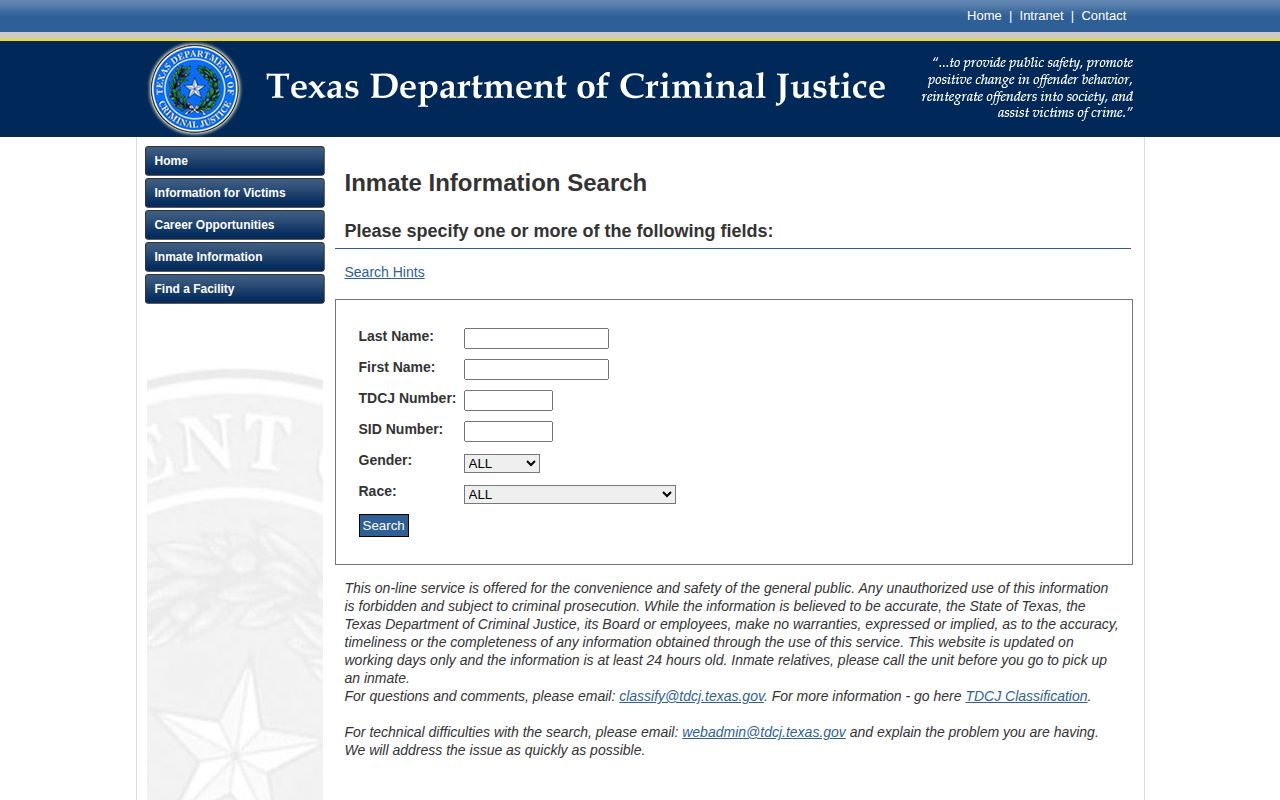
The screen is a current-incarceration lookup, so save relevant fields and use final-status channels after release.