
Borden County Release Date Meanings
A projected release date is a calculation, not a completed event. TDCJ Classification and Records calculates it from sentence facts, eligibility rules, and credit. A scheduled release date appears after approval and release processing have moved farther along. TDCJ may also list a scheduled release location. Actual release is the custody event recorded when the person leaves that agency. Discharge is later when a sentence or supervision obligation ends.
Maximum expiration is another distinct term. It marks the end of the sentence as computed, subject to lawful changes. A person may leave prison before that date on parole or mandatory supervision. In contrast, a Borden pretrial detainee may leave on bond or court order with no sentence-based projection. Transfer from a contract jail to TDCJ or ICE ends one custodian's hold but does not mean community release.
| Date or status | What it means |
|---|---|
| Projected release | A current calculation that can change. |
| Scheduled release | Processing has advanced, but release is not complete. |
| Actual release | The custodian records the physical exit or transfer. |
| Discharge | The sentence or supervision duty has ended. |
| Maximum expiration | The computed sentence endpoint if no earlier lawful release controls. |
Find Borden County Projected Release Dates
Begin with the sentence and physical custodian. Borden County does not operate a currently certified jail and houses prisoners elsewhere. The Sheriff's Office knows where a Borden arrest was sent. The housing jail controls its operational release calculation. TDCJ controls state-prison calculations. A federal sentence belongs in the BOP system, not the TDCJ search.
- Call Borden County Sheriff at 806-756-4311 to identify the jail that held the booking.
- For county custody, ask that jail for the sentence start, jail credit, holds, release calculation, and final release or transfer entry.
- Request the Borden judgment and jail-credit terms from the County/District Clerk to check the legal basis.
- For state prison, search the TDCJ inmate system by TDCJ or SID number when possible.
- Open the correct detail and record the status, offense, conviction county, projected date, parole fields, and data date.
- After the event, verify actual release through TDCJ, the Parole Status Line, IVSS history, or a narrow records request.
The state search contains only people currently incarcerated in a TDCJ facility. It updates on working days, and its information is at least 24 hours old. A no-result after the expected date does not certify release. Preserve the pre-release detail, then build the post-event record chain. The VINE inmate check guide explains the separate county and state notification systems.
Borden County TDCJ Date Fields
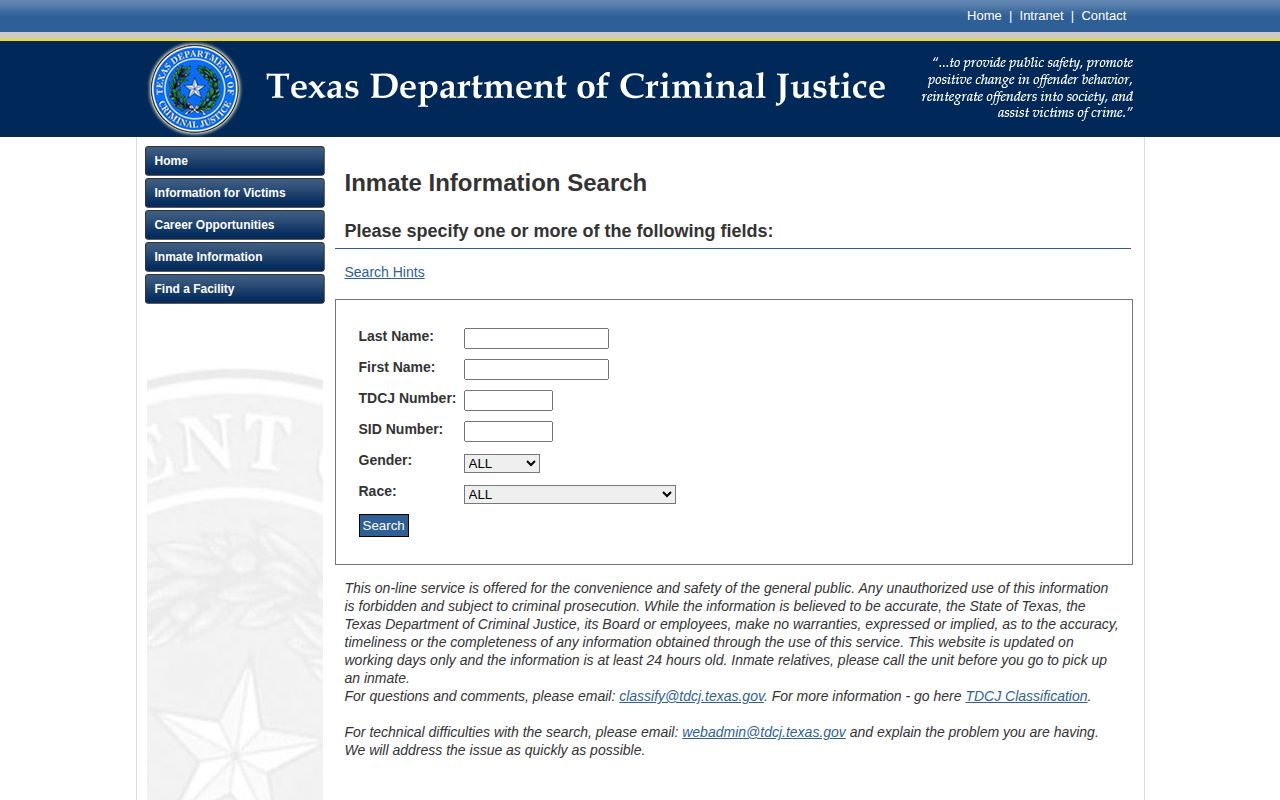
TDCJ lets a searcher use a TDCJ number or state identification number. A name search requires the exact last name and at least a first initial, with optional gender and race filters. Compare identifiers, conviction county, offense, and sentence before relying on the match. Borden as conviction county links a state record to the case. It does not mean the prison is in Borden County.
Start with the official TDCJ offender search and read the displayed data date.
If the online match is unavailable, TDCJ's free email information route can supply the TDCJ number, location, conviction offense, incarceration history, current offense and court, and projected release date. Send the full name and seven-digit TDCJ number to pia@tdcj.texas.gov. Without the number, provide exact birth date or approximate age and conviction county. TDCJ says that email route does not provide photographs.
Borden County Good-Time Rules
Texas Government Code Chapter 498 governs good conduct time. Good time is a privilege used in eligibility or sentence calculations, and it may be forfeited for disciplinary reasons. It is not an automatic reduction of the sentence imposed by the court. For some eligible offenses committed before September 1, 1996, flat time plus good time can reach mandatory supervision. Later eligible cases also require BPP approval, while excluded cases may project to maximum expiration unless parole occurs.
Offense date matters. So do offense type, concurrent or consecutive sentences, jail credit, and the law in force. Government Code §508.145 sets parole eligibility categories. Section 508.149 lists mandatory-supervision exclusions. A public reader should not use one formula across cases or promise a day based only on sentence length.
No Universal Borden County 85% Rule
The common claim that every Texas prisoner must serve 85 percent is wrong. This is Borden County's distinctive release-date trap when a local case moves into TDCJ. For listed offenses, Government Code §508.145(d) can require actual calendar time equal to one-half of the sentence or 30 years, whichever is less, with a minimum of two calendar years. Good-conduct credit is not added to meet that calendar-time threshold.
Other offenses and dates follow other rules. Mandatory supervision may be excluded under §508.149. Some cases combine flat time and good time subject to BPP review. Federal practice is often the source of the 85 percent phrase, but a Borden-to-TDCJ sentence is governed by Texas law. Read the actual offense, offense date, and TDCJ computation.
The distinction also explains why projected and scheduled dates can differ. Parole approval, program conditions, release-plan review, and certificate audit can move a case from eligibility into processing without completing release. TDCJ's parole release FAQ warns that scheduled information can change even on release day.
What Changes Borden County Release Dates
A projected date can move for legal, disciplinary, or administrative reasons. The agency that owns the calculation should explain the current result. A court docket may show a new order, but the jail or TDCJ still records the operational change.
| Change | Possible effect | Record to check |
|---|---|---|
| Good-time loss or restoration | Changes an eligible TDCJ calculation. | TDCJ Classification and Records. |
| Amended jail credit | Moves the sentence calculation. | Court order and custodian calculation. |
| Consecutive case | One term may follow another. | Judgments and TDCJ sentence data. |
| Detainer or hold | Release may become transfer. | Final custody entry and receiving agency. |
| BPP action | Approval, denial, or program condition changes the path. | BPP result and TDCJ status. |
| Release-plan review | Scheduling can wait on residence or certificate processing. | Review and Release Processing. |
A favorable parole result is authorization, not a gate timestamp. FI-1, FI-2, and treatment-based FI codes each have distinct meanings. Keep the code intact. Then confirm whether TDCJ issued a certificate, scheduled a date and location, and completed release. If another authority assumes custody, describe the event as a transfer.
Borden County Jail Date Calculations
County jail time follows a different route. The judgment, sentence start, presentence credit, concurrent or consecutive terms, and outstanding holds matter. Because Borden pays to house prisoners elsewhere, the physical jail performs the operational calculation. Garza County has historically housed Borden prisoners, but that evidence does not prove Garza held a particular person today. Call the Sheriff first.
No official source publishes Borden-specific weekend release practice, holiday adjustment, bond-processing time, or transport schedule. Do not move a projected date to Friday or Monday based on a generic rule. Ask the actual jail how it applies the judgment and when staff expect processing to finish. Court authorization can occur on one day while a hold keeps the person confined until the next.
Note: Ask whether the stated date is a calculation, a scheduled processing date, or a completed release timestamp.
Confirm Borden County Actual Release
After the expected date, seek an event record. For outsourced jail custody, request the final release or transfer entry with date, time, reason, destination, and code definition. Reconcile it with the Borden court order. For TDCJ, use the Parole Status Line at 844-512-0461, state IVSS notices, the assigned parole office, and a narrow public-information request for release date, type, location, final status, and discharge date.
A sound log labels each item. The projected date is a prediction. A bond order or parole vote is authorization. The jail or prison timestamp is the custody event. A parole assignment is supervision status. A discharge order is the later endpoint. This method makes apparent conflicts understandable and prevents a current-inmate search from being misread as an archive of released people.
Borden County Date Record Requests
When a screen does not answer the date question, request the existing calculation and event fields from the agency that owns them. For an outsourced Borden jail stay, ask the Sheriff to identify the housing jail, then request that jail's booking sheet, sentence start, jail-credit entry, holds, final release calculation, and release or transfer log. Ask for the meaning of any local disposition code. The Borden clerk can supply the judgment, sentence, bond order, and amended credit order, but the court record does not establish the minute jail staff completed processing.
For TDCJ, the public-information request can seek an existing release certificate, public release date and type, release unit or location, incarceration history, final status, and discharge date. Submit it through TDCJ's designated online form or to PIA@tdcj.texas.gov. The agency also accepts mail at TDCJ Public Information Request, PO Box 4017, Huntsville, TX 77342. Government Code §508.313 protects parole-file information, and §§552.134 and 552.029 affect inmate disclosures, so lawful redaction may narrow the response.
TDCJ's posted cost guidance says fewer than 50 paper pages generally cost ten cents per page plus delivery. Larger work may include personnel and overhead charges. If an estimate exceeds $40, TDCJ instructs the requester to respond in writing within ten days. Those are state-agency rules, not a Borden Sheriff fee. A focused request for named date fields is more useful than asking for an entire file.
Audit A Borden County Date
Create a timeline rather than forcing every source into one date. Record when each search was run, the identifier used, the system's “as of” date, and the exact phrase displayed. Classify projected release as a prediction, a bond order or favorable parole vote as authorization, a jail timestamp as a custody event, an office assignment as supervision status, and discharge as the sentence endpoint.
This approach explains common gaps. A judge may authorize release on Monday, a detainer may keep the person held until Tuesday, and the physical jail may then record transfer instead of community release. TDCJ may record admission later. Each source can be accurate within its own role. When dates conflict, preserve both labels and ask the responsible custodian to explain its field rather than selecting the earlier date.
Public Record Search
Sponsored Results